
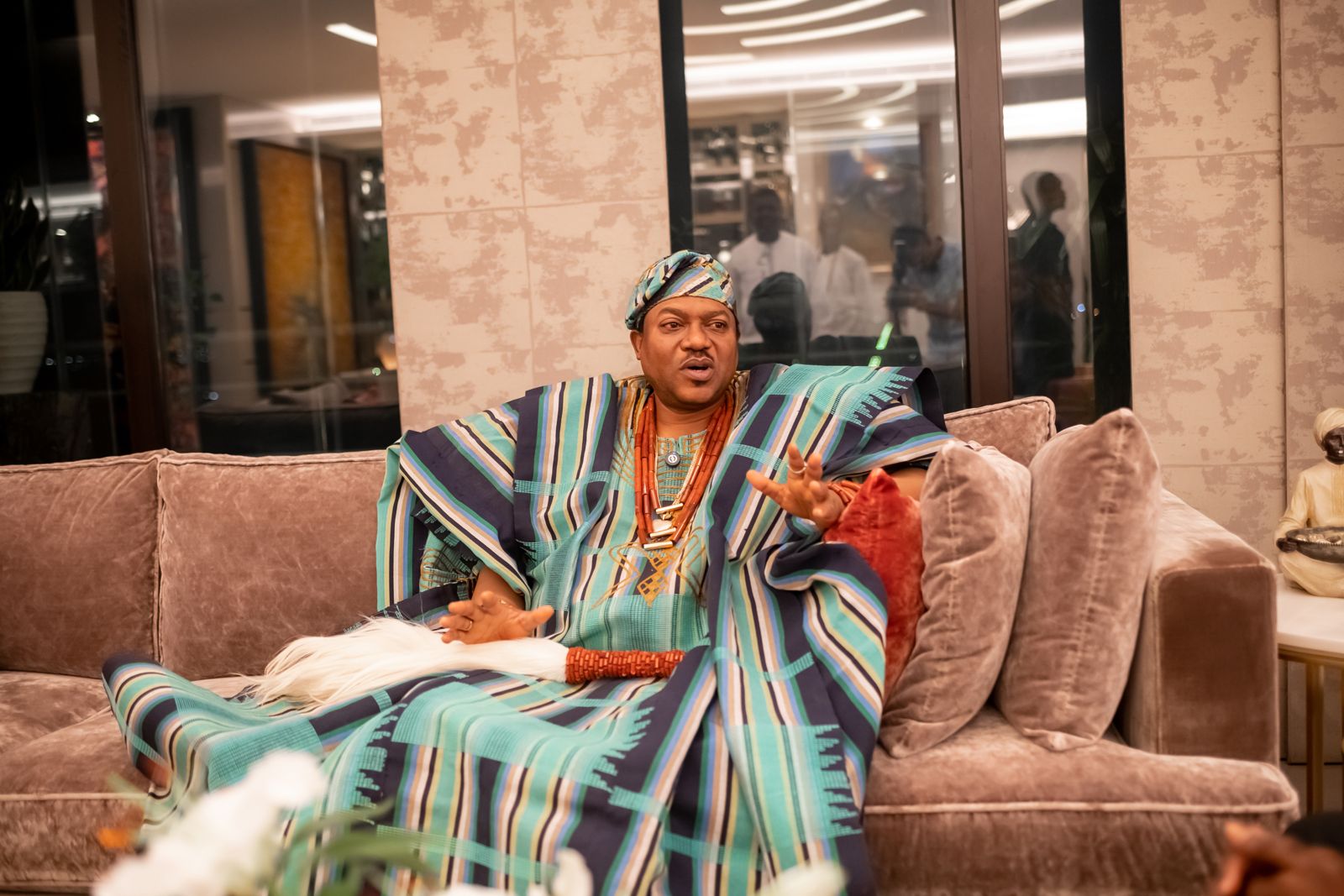

By Eric Elezuo
As the annual Igogo Festival takes centrestage in Owo, Ondo State, the custodian of culture and tradition of the Owo people, His Royal Majesty Oba Ajibade Gbadegesin Ogunoye III, the Olowo of Owo, has taken time to educate both natives, residents and lovers of good things about the expectations of the 2026 edition of an event that has spanned 600 years.
In this interview with The Boss, the revered royal father went down memorylane to bring to the fore the intrigues surrounding the festival, the incident that originated the fiesta, and the joy that heralds stretched ceremonies, noting that the event has come of age, and has become a fusion of the culture and modernity, incorporating the youthful manifestations without sidelining the ever consistent tradition of the people.
Excerpts:
How would you love to introduce yourself, sir
I am His Imperial Majesty Alaiyeluwa Oba (Dr.) Ajibade Gbadegesin Ogunoye III, the Olowo of Owo, Paramount Ruler of Owoland, and Chairman of the Ondo State Council of Obas. Thank you.
Tell us how far you have affected the lives of the people of Owo, Ondo State and of course, everybody who believes in you.
Well, I practically lived with my father while growing up, when he was on the throne as the Olowo of Owo. He reigned between 1968 and 1993; about 25 years. So, I was with him throughout; I learned under him.
Within the period, I immensed myself in the culture and tradition of our people. Again, my educational background as well as my journey in the public service of Ondo State, and everything, really prepared me for the future.
I eventually retired voluntarily from the civil service when the stool of the Olowo became vacant in 2019. I retired as a permanent secretary. I was then serving in government as protocol. So, I ascended the throne eventually, in response to the call of the good people of Owo. I know everything is about service, and so I was prepared to give maximum service to my people. And more importantly, not only to preserve, but to promote the culture and tradition of Owo.
In Owo, you will see culture at its best, and we express it more during our festivals, particularly during Igogo Festival, which is one of our many festivals. A culture that was handed down to us by our forefathers, and it has evolved ever since.
For how many years have this tradition evolve?
For more than 600 years. Yes, for more than 600 years. It was not really a script. It evolved out of our relationships, the experiences of our people, of our forefathers, and it was a natural occurrence, as well as very spiritual. Ever since, we’ve been celebrating it, and at a time in our life, it nose-dived, but when I ascended the throne, I saw a need to re-present ourselves to the world. That was why I started re-packaging it, to promote it for global cultural tourism. And it’s been evolving and expanding over the years.
What would the people see different from what has been happening in previous years as this year’s festival takes centrestage?
Yes. The festival always holds for a period of 17 days. It’s cultural and traditional, and we felt that it’s a culture that must be given to the youth. As a result, we’ve decided to incorporate modern aspects and activities into it. Consequently, we’ve introduced the Oronse Pageant. You know, Oronse was the goddess that the festival revolves around.
We’ve also introduced the Olowo’s Cup, a football tournament, and the finals will be played during the festival. Then, there’s a traditional wrestling competition, which we’ve repackaged to meet modern trends.
We have equally introduced other sports such as tennis, monopoly, traditional sports likes of ayoo, and many more. This is to ensure that the youths are attracted as they are the real inheritors.
What are the dos and don’ts of the festival?
During the festival, it’s forbidden to play leather drums. What is usually played is the gong. We call it Agogo. That’s where the name Igogo festival came from; a mild distortion of Agogo festival. We’ve also introduced an aspect where after the festival, everyone gathers to play leather drums. It’s another big celebration that affords the people another opportunity to merry. We call it Owa Lopo.
Owa Lopo means the king will sit on his throne in splendor, being people coming around in groups, age grades, different title chiefs will come to pay obeisance and to marry. Thank you. And eventually, the king will pray for the kingdom, for the indigene, and for even for government.
So sir, can we comfortably say that the 2026 Igogo Festival is a fusion of modernity and ancient culture and practices?
Yes, that’s just it. The traditional aspect is sacrosanct. We don’t play with it. Everything will run through its normal course. But the modern aspects will just be part of the days of the festivals.
So, with these extra steps, the target is basically the youths
Everybody, so to say. Global tourists from across the world are not exempted. People come from places like Australia, Canada, UK, US, Brazil and more to be part of the festival. And this year’s own will be different in many positive ways.
As we round off, I remember you mentioned something about the Oroshe Pageant, and the goddess behind it. Could you please throw more light?
The whole story of Igogo Festival started around Queen Oroshe. The story was told that during the reign of Olowo Reren Gendje, a damsel suddenly appeared in the kingdom. She was very beautiful, extreme beautiful. Nobody knew her source.
When the king was told, he ordered that said lady be brought before him. And when she came, the king was captivated and taken in by her beauty, and immediately requested her hand in marriage. But she refused. She said she was not interested, and the king asked why.
She told the king that she had taboos that must never be broken. As a result of that, she would never marry the king. But the king assured her that the taboos would be respected. On further enquiries, she itemized three donts, including that a bowl of water must never be splashed on the ground in her presence. Secondly, that a bundle of firewood carried on the head must never be thrown on the ground in her presence; and finally, that okra must never be pounded in her presence. The king agreed, and promised that everything will be kept.
Eventually, they got married, and Oroshe arrived the palace. The love between the two was manifold, and very obvious. This inflamed the jealously in the other wives of the king. They became very jealous of her, and somehow found out the taboos Oroshe abhore. A day came when the king went on hunting expedition, the other wives broke all the taboos one after another. In anger, she left the palace immediately, and went into the thick forest of Ugbolaja.
When the king returned, and discovered what had happened, he was both confused and sad. The king didn’t know what to do. After much thought, he assembled a team of young, able-bodied, and powerful men from the Iloro quarters to go in search of her. The Iloro were set of people that accompanied the Olowo when he was coming from Ife, to establish our kingdom, and we have five quarters.
While on the search in the forest, they found a head gear, called gele, on the floor. So, they marked the place out. The more they explore the forest, the more it grew, and again, they found a pin in anothe location. It was one of those traditional pins that women plait their heads with in those in those days. Suddenly, the Queen appeared to them. So, they made entrities to her, pleaded with her to return to the palace with them, but she refused. She said she was no more interested and there was no way she could come back again since her taboos had been broken.
She however, promised that in spite of everything, she will continually be at peace with the kingdom, protect the kingdom while demanding that the king should still institute a festival in her honor.
She also requested that during the festival, no leather drum should be beaten; only gongs (agogo). Other requests of hers include no booming of guns, no coverage of the head, and a few more others.
It would be recalled that during the good days when the Queen was still in the palace, one of her requests was that a room be provided for her where she would be defecating, and that the king should go there afterwards. Her request was granted. However, when the king entered the room, after her defecation, the king did not find feces, but beads of different sizes, shapes and forms, just like the one I’m using now. Heaps of them. She later confessed that she came purposefully to bless the king.
In a nutshell, Queen Oronshe was a spirit being. She was a goddess and not a natural person. That explains why our beads are quite different from others.
Very unique to us, and we are blessed with it. That is why during the festival, you see the olorowo in different forms of of beads, chieftaincy, and endowment brought to the kingdom by Queen Oronshe. That was how the festival started. It was a a festival that evolved in the course of our life, not necessarily just put in place by anybody.
Quite an exposition, sir
Thank you.
And your final note, sir
Everything we are doing is geared towards empowering the youths, through pageantry, football competition, wrestling, and many more. This is so that our younger ones will know our culture and tradition, as well as our history.
It’s imperative to note that a society without culture and tradition is in peril. That’s just it. In Owo, we make sure we not only protect, we also promote our culture and our tradition. Thank you very much.
We thank you for your efforts at preserving the tradition, and providing desired leadership for the people
Yes, thank you. But note that we are not only preserving, we are also promoting it to meet international global cultural tourism standard.
One more time, thank you for keeping the culture, not only of Owo, but also making Nigeria a cultural entity in the global world.
The pleasure is mine
We wish you a splendid 2026 Igogo Festival celebration
Thank you. I appreciate.